
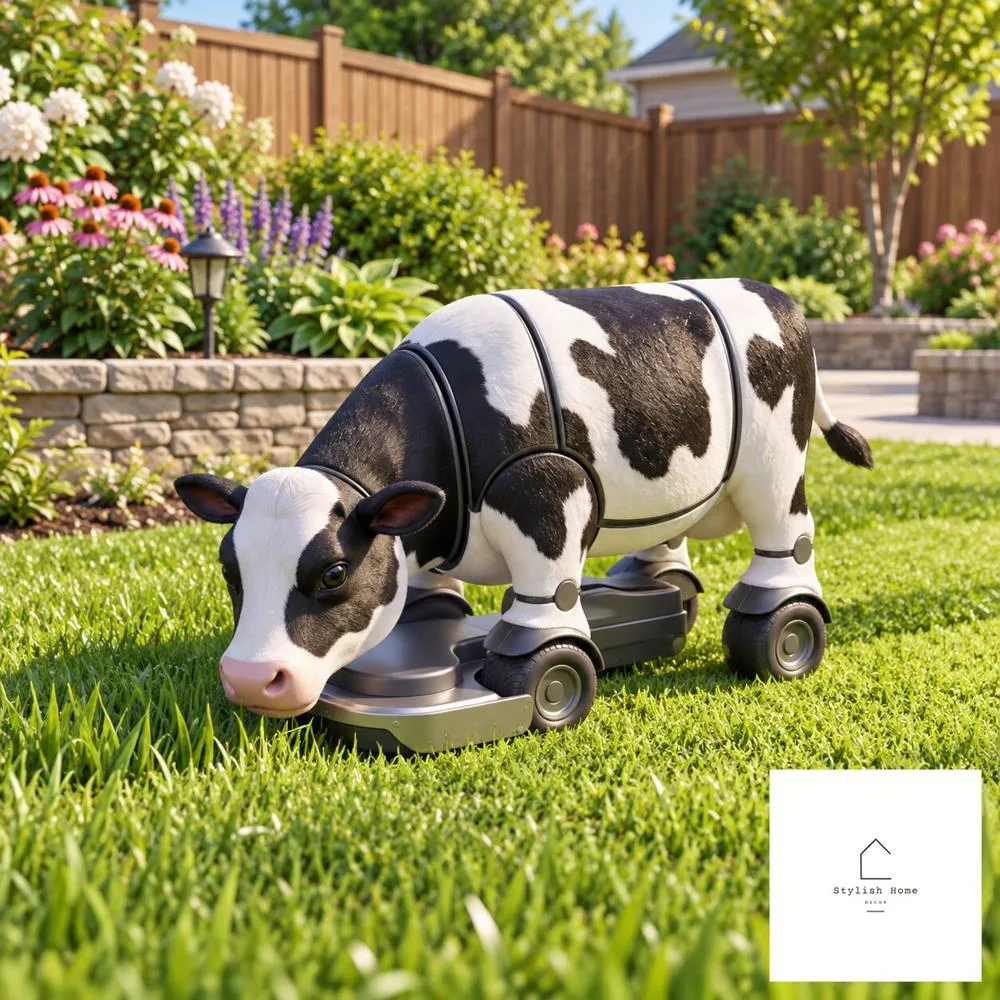
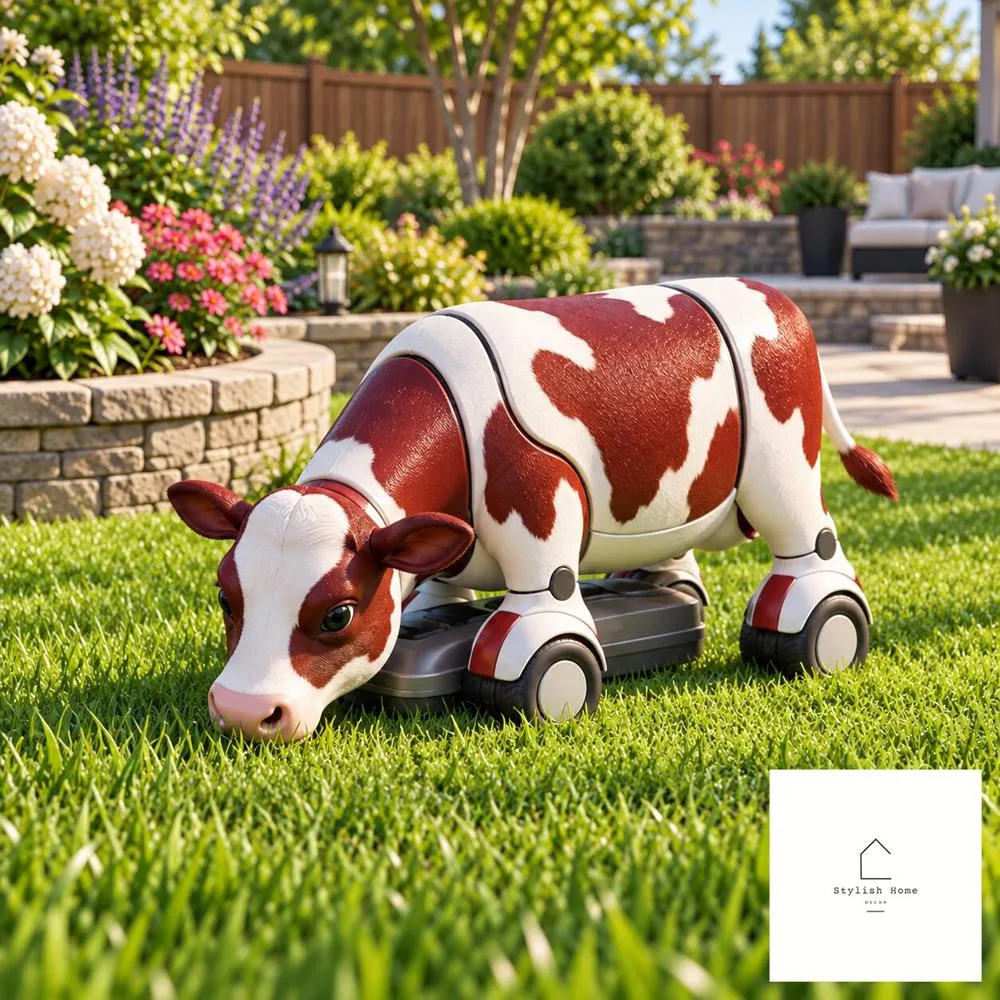
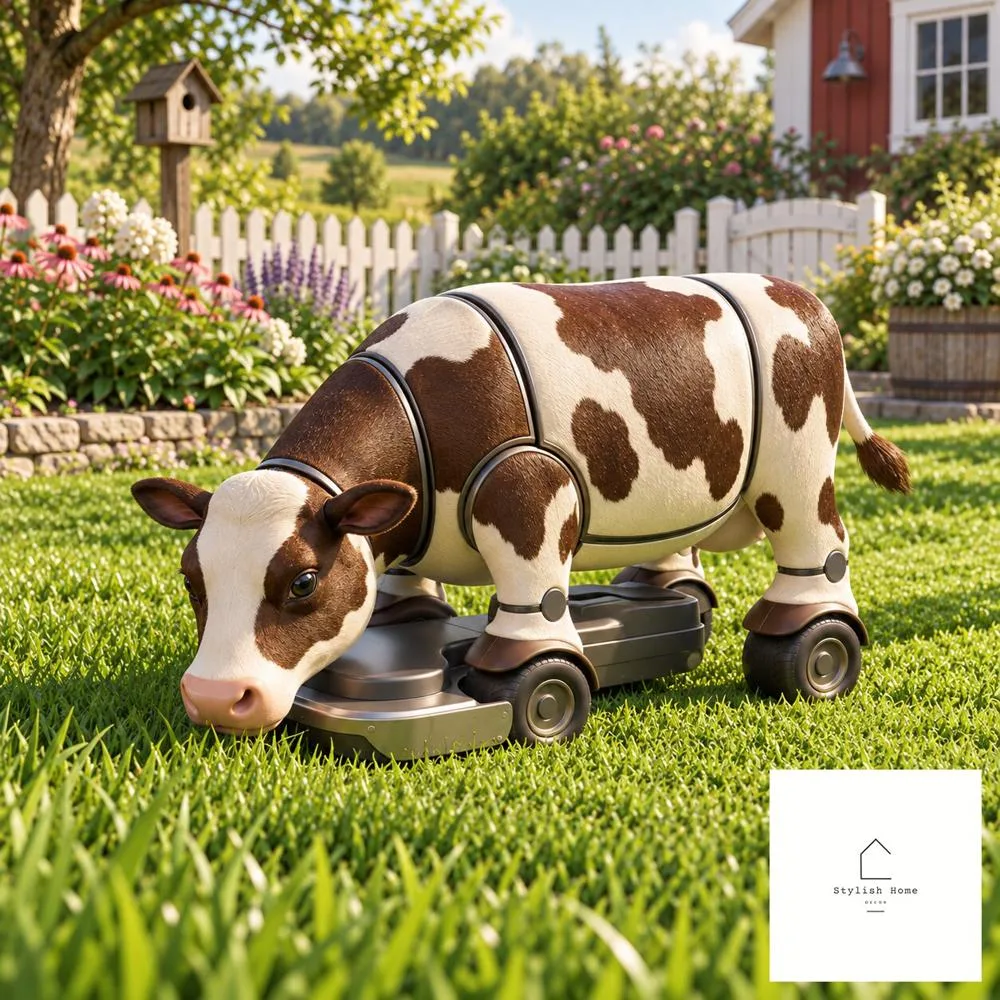
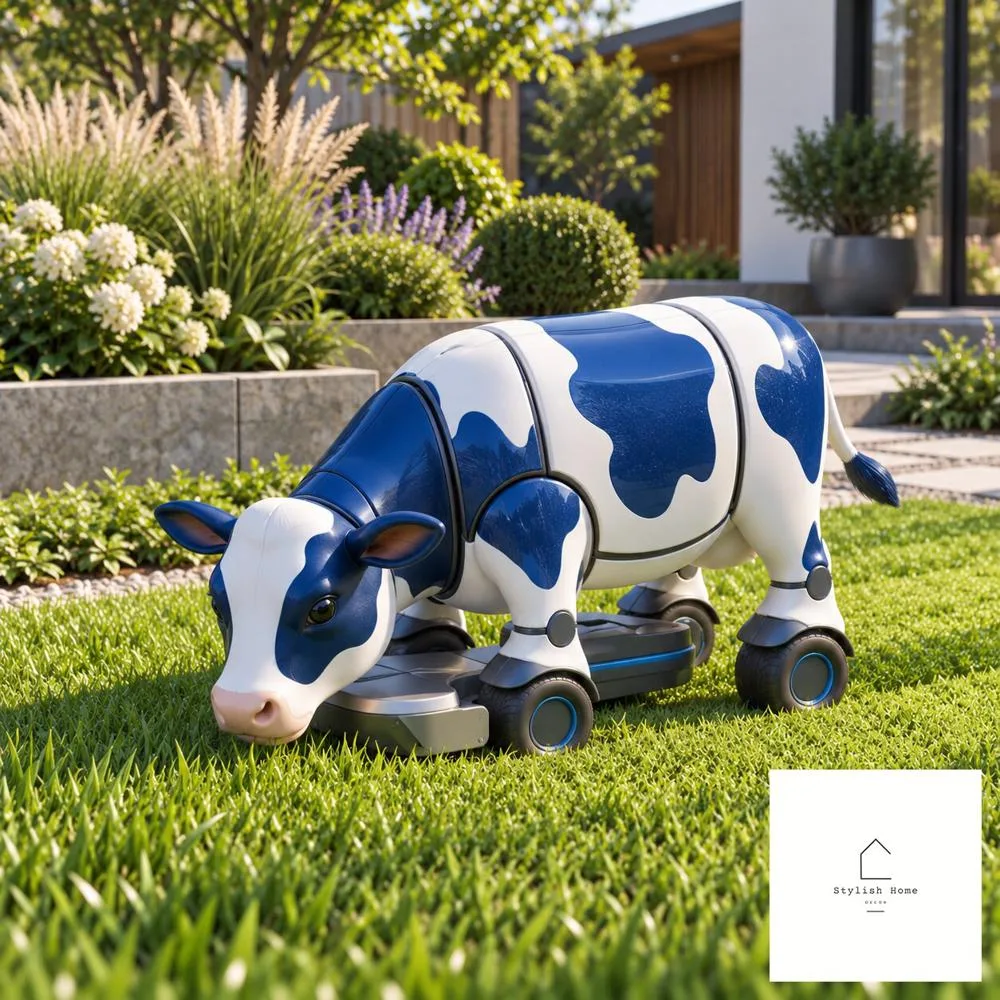
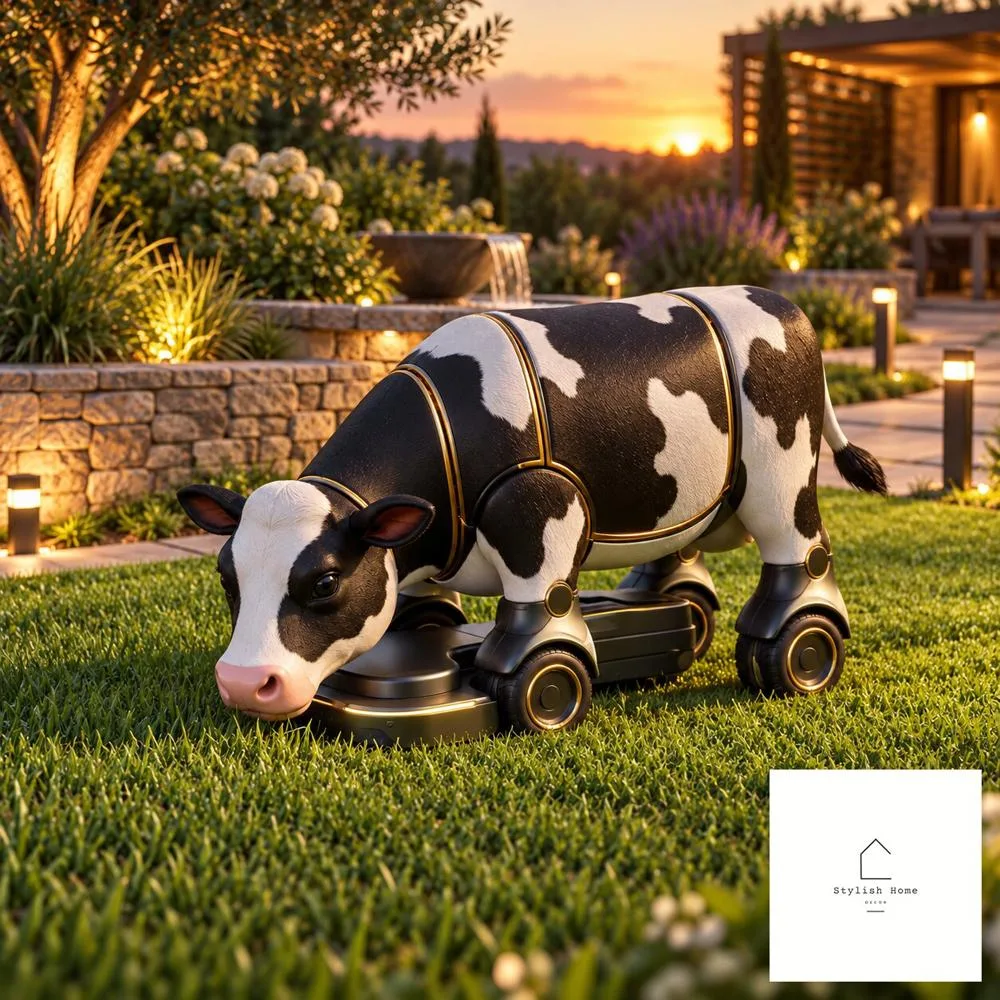
There’s something quietly poetic about the idea of a robot cow grazing your lawn.
No mooing. No mess. No early-morning interruptions. Just a tireless, intelligent machine — inspired by one of nature’s most patient grazers — methodically working its way across your grass, trimming, planning, adapting. While you sleep, sip your morning coffee, or simply breathe.
That’s the vision behind the robot cow lawn mower: a concept so brilliantly simple it almost feels like someone looked at a field of cattle doing their slow, methodical thing and thought, “What if we could automate that?” And then they did.
Whether you’re a homeowner fed up with spending your Saturdays behind a thunderous gas mower, or a commercial landscaping company looking to reduce labor costs without sacrificing quality, the robot cow lawn mower — and the broader world of autonomous robotic mowing it represents — is changing the conversation around lawn care forever.
Let’s dig deep into this extraordinary innovation, explore what it can do, and understand why it’s not just a gadget — it’s a genuine turning point.
What Exactly Is a Robot Cow Lawn Mower?
The Concept That Started in a Pasture
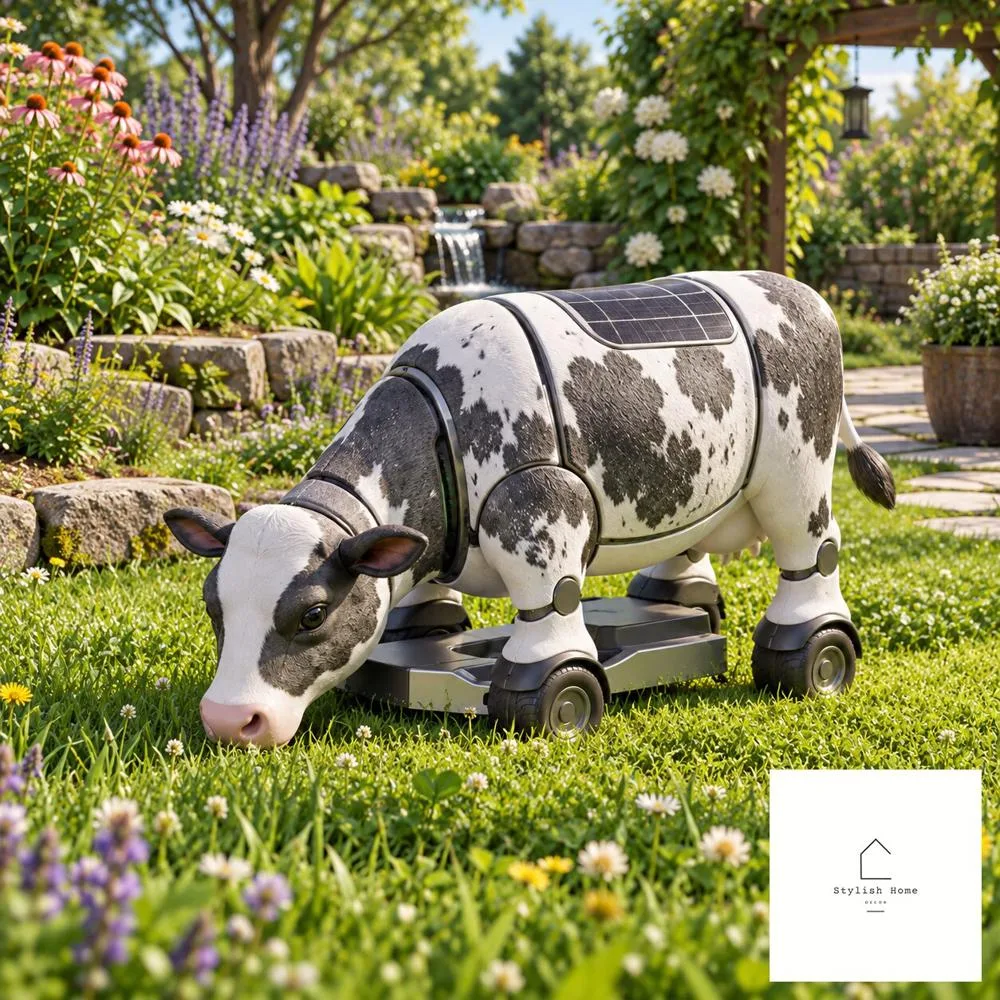
The name “robot cow lawn mower” isn’t just marketing flair — it has real roots in agricultural science. Researchers at the University of Minnesota developed what they called the “CowBot” — an autonomous lawn mower designed specifically to cut down weeds in cattle pastures. As researcher Parikshit Maini described it, “It’s like a Roomba for an agricultural farm.”
The logic was beautifully simple: when cattle graze these farms, they eat the soft, grassy plants and leave behind the weeds. Once they have grazed all of the field, the robot mower goes in and cuts down what the cows left behind.
In other words, the robot cow for cutting was born not in a tech lab in Silicon Valley, but in the muddy, sun-drenched reality of working farmland. That matters. It means this technology was engineered to solve a real problem — the kind that makes farmers’ backs ache and their schedules impossible.
From Pasture to Property: A Technology That Scaled
What began as an agricultural experiment has since evolved into something far broader. The robot cow lawn mower concept — an autonomous machine that grazes your lawn with the same patient efficiency of a bovine — is now shaping residential yards, golf courses, sports fields, corporate campuses, and beyond.
A robotic lawn mower is an autonomous robot used to cut lawn grass. Modern robotic mowers are increasingly sophisticated, are self-docking, and some contain rain sensors, nearly eliminating human interaction.
The robot cow lawn mower takes that foundation and supercharges it with precision navigation, AI obstacle detection, and — in commercial models — the raw endurance to work acre after acre without ever asking for a break.
The Heart of the Machine: How a Robot Cow Lawn Mower Works
Navigation, Intelligence, and the Art of the Grazing Pattern
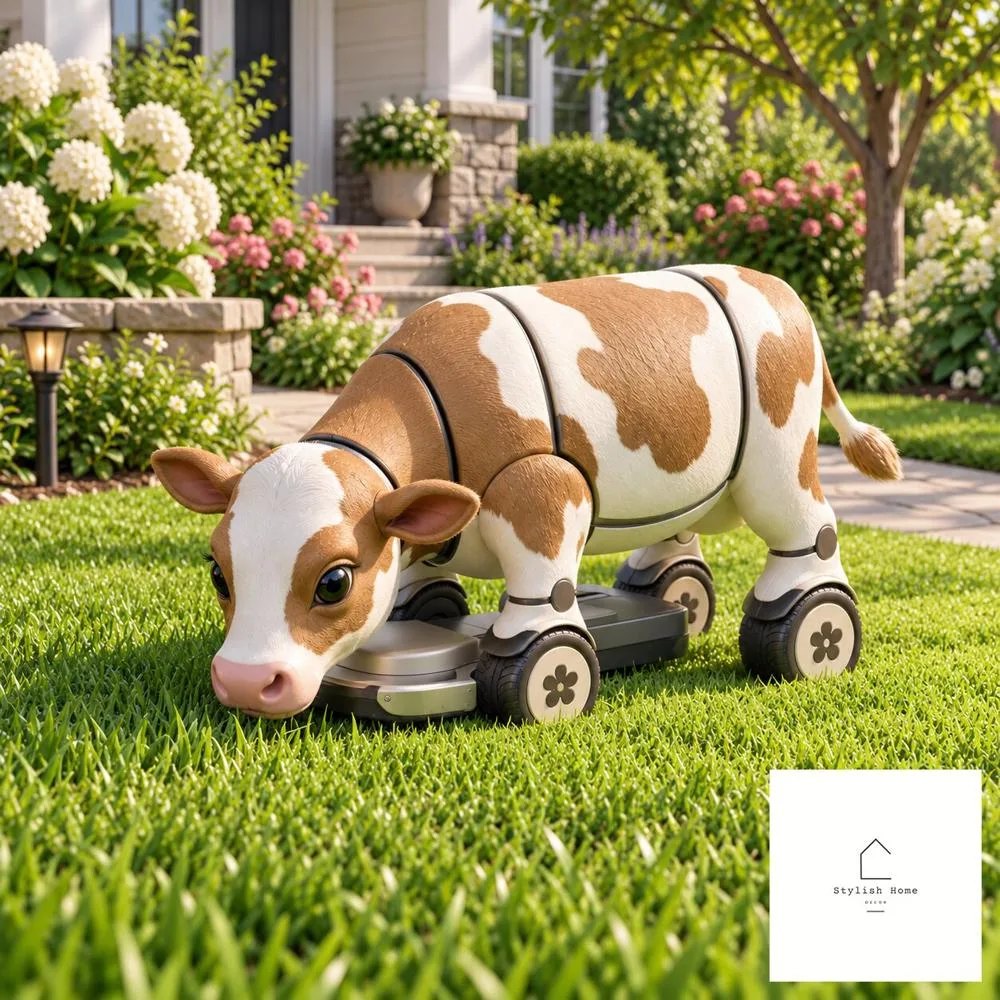
One of the most fascinating things about the robot cow for cutting is how it thinks. Early robotic mowers bounced around randomly, like a pinball inside a wire boundary. Modern machines are smarter — dramatically smarter.
Unlike a Roomba in a living room, a pasture-mowing robot has to account for things like slope, obstacles, and how thick the weeds are. On a flat open field, a spiral pattern starting on the outside and working in is the most efficient, but a back-and-forth pattern — perhaps skipping rows to account for turning space — may be needed in other cases.
This adaptive intelligence is what separates a true robot cow lawn mower from a simple automated trimmer. The machine reads its environment, selects its strategy, and executes — hour after hour, day after day.
High-end models now use technologies like LiDAR scanning, RTK satellite positioning, AI cameras, and even ultrawide-band communication signals to navigate even the most complex terrain — shaded tree corridors, sloped hillsides, narrow garden beds — with pinpoint accuracy.
Built to Endure
The CowBot — built on the Toro Groundmaster platform and modified to run on a 28.8 kWh electric lithium battery pack — incorporates a suite of safety features including a wireless remote emergency stop button, pressure-activated perimeter bumpers, and emergency stop knobs on both the front and back of the mower.
That’s not a toy. That’s a serious machine built to work in conditions that would send most humans back indoors.
Robot Cow Lawn Mower with Attachments: More Than Just a Cutter
The Modular Future of Lawn Care
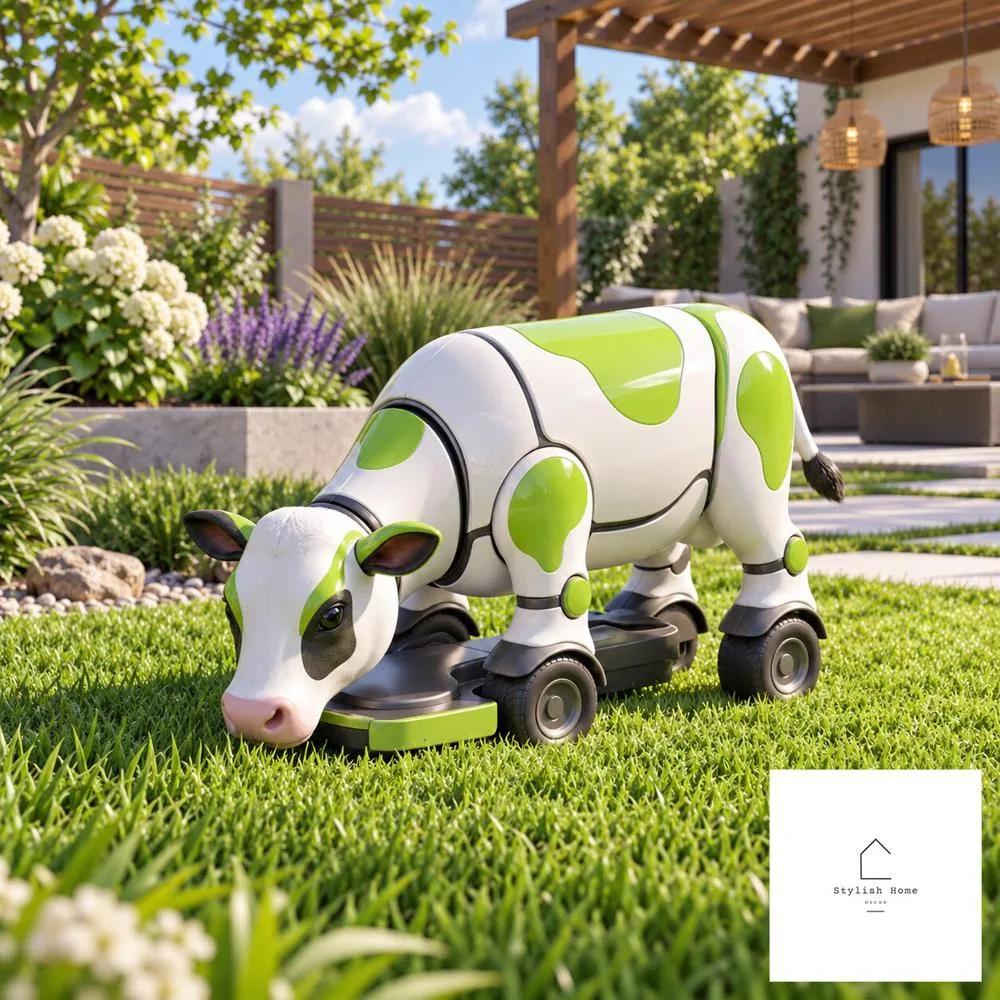
One of the most exciting developments in the world of the robot cow lawn mower with attachments is just how versatile these machines are becoming. Buying one isn’t just buying a mower — it’s investing in a platform.
Commercial-grade mulching and aerator attachments are expanding in demand as sustainable lawn care practices rise globally. Meanwhile, the broader lawn mower attachments market — which includes robotic systems — was valued at over $3.24 billion in 2023 and is projected to reach $5.92 billion by 2032.
For the robot cow lawn mower with attachments, that means you can transform the same base unit into:
- A mulching powerhouse that chews clippings into fine particles and feeds them back into the soil as natural fertilizer
- A dethatching tool that breaks up the suffocating layer of dead material between your grass and the soil
- A flail-deck weeding implement — exactly like the one used on the original CowBot — custom mounted with high ground clearance to achieve a cut height of 20 cm (8 inches), perfect for thick, unruly pasture weeds
- A snow-clearing attachment for winter landscapes where the robot cow never truly rests
The ability to swap attachments means one robot cow lawn mower can handle your lawn’s needs across every season — a genuine year-round partner rather than a single-purpose gadget.
Smart Technology Meets Practical Versatility
Robot attachments with AI navigation technology exploded in Europe during 2024, reducing operator exhaustion and delivering consistent mowing quality to both homes and business lawns. The trend is now global. From suburban gardens in Ohio to commercial estates in Singapore, the robot cow lawn mower with attachments is proving that versatility and autonomy aren’t opposites — they’re partners.
Robot Cow Lawn Mower for Commercial Use: The Industry Is Paying Attention
Why Businesses Are Switching
For property managers, landscaping companies, golf course superintendents, and facility directors, the robot cow lawn mower for commercial use isn’t a novelty — it’s a strategic business decision.
The numbers tell the story clearly. The robotic lawn mower accessories market alone was valued at $352.1 million in 2024 and is projected to reach $526.1 million by 2032, advancing at a compound annual growth rate of 5.3%. That kind of sustained investment signals an industry that has fully committed to autonomous mowing as its future.
And it’s easy to see why. John Deere’s commercial-grade robotic lawn mower — powered by a 21.4 kWh battery — is built to operate for up to 10 hours, uses four pairs of stereo cameras to see in 360 degrees, and because it’s electric, runs far quieter than gas-powered predecessors, allowing jobs to start earlier in the morning.
Earlier starts. Longer runs. Quieter operation. Dramatically reduced fuel costs. For a commercial landscaping operation, these aren’t small wins — they’re competitive advantages.
Commercial Models: Power, Precision, Scale
Commercial robotic mowers are revolutionizing the landscaping industry with their precision and efficiency. Popular models include the Husqvarna AUTOMOWER 550, the Husqvarna AUTOMOWER 550 EPOS, and the Husqvarna AUTOMOWER 535 AWD, with prices starting from approximately $5,900.
The Automower 535 AWD EPOS, for instance, is ideal for professionals needing a robotic solution for hilly areas on medium-sized commercial turf — including golf courses, sports fields, and facilities.
On the agricultural side, models like the Kress KR236 can mow up to 9 acres, built like workhorses — sealed to withstand weather, packed with industrial-grade parts, and designed for relentless operation.
This is what robot cow lawn mower commercial performance looks like at its peak: machines that don’t tire, don’t complain about the heat, and don’t clock out at 5 PM.
The Emotional Truth Behind the Robot Cow Lawn Mower
It’s Not Just About Convenience — It’s About Time
Here’s something the spec sheets don’t tell you.
Lawn care, for millions of people, is a thief. It steals weekend mornings. It steals quiet evenings. It steals the spontaneous family barbecue because the grass “needs doing.” It’s one of those obligations that sits at the back of your mind like a quiet, persistent anxiety — always there, always waiting.
One homeowner who made the switch put it simply: “We love our automower — it gives us more family time on the weekends. It’s easy, quiet, low maintenance, and kid friendly.”
That’s not a product review. That’s a life improvement.
The robot cow lawn mower isn’t just cutting grass. It’s handing back something that modern life has quietly taken — time, headspace, the simple joy of a Saturday that belongs entirely to you.
Sustainability That Actually Matters
The environmental story of the robot cow for cutting is equally compelling. These machines are predominantly electric — generating zero direct emissions, dramatically reducing noise pollution, and consuming a fraction of the energy of traditional gas mowers.
Smart systems allow for remote-controlled operations and automated adjustments that improve energy efficiency, and robotic mowers use weather data and lawn need analysis to schedule their operations automatically, conserving battery power when not required.
The CowBot was even designed to recharge via an off-grid solar-powered charging system, using a solar array of about 3.1 kW to meet the daily energy needs of its 29 kWh battery pack.
A solar-powered, autonomous, grazing robot. Nature called — and technology answered.
Choosing the Right Robot Cow Lawn Mower for Your Needs
For Homeowners
If your lawn is under an acre and you want a set-and-forget solution that keeps your yard looking professionally manicured without any effort on your part, entry-level to mid-range robotic mowers — many of which now operate completely wire-free — are a smart, life-changing investment.
Look for models with GPS or RTK navigation, rain sensors, smartphone scheduling, and obstacle detection. Wire-free models, in particular, have surged in popularity for their ease of setup and clean operation.
For Commercial Properties and Landscapers
If you manage a golf course, corporate campus, sports complex, or multi-acre estate, the robot cow lawn mower commercial tier is where you belong. Here, look for:
- Large cutting widths (up to 44 inches in some commercial models) for covering maximum ground efficiently
- All-wheel drive capability for slopes and uneven terrain
- Fleet management software that allows multiple units to be coordinated across a single large property
- Attachment compatibility for multi-season use
In January 2025, John Deere introduced its new electric autonomous zero-turn mower at CES 2025 — featuring built-in batteries, reduced noise and emissions, and the ability to be used both automatically and manually, with remote scheduling, performance monitoring, and on-the-fly modifications from a distance.
Commercial buyers at this level are making an investment that pays dividends in reduced labor costs, lower fuel bills, and a consistently pristine result that keeps clients renewing contracts.
For Agricultural and Pasture Applications
For the truest “robot cow” application — autonomous mowing in cattle pastures, agricultural fields, and large open rural properties — look toward purpose-built or modified commercial platforms.
The original CowBot design used a flail-deck weeding implement custom mounted with high ground clearance, safety bumpers, and emergency stop systems to operate safely in open pasture environments. This agricultural-grade design philosophy — durability, safety, adaptability — should be your guiding standard when choosing a machine for serious farm or pasture use.
The Future of the Robot Cow Lawn Mower
The robot cow lawn mower is not a peak — it’s a beginning. The robotic lawn mower accessories market is expected to advance from $352.1 million in 2024 to $526.1 million by 2032. That growth is being driven by advances in AI, battery technology, solar charging, LiDAR mapping, and machine learning — all of which will make future generations of robot cow mowers smarter, faster, longer-lasting, and more affordable.
We’re moving toward a world where a fleet of robot cows quietly grazes your property in perfectly orchestrated patterns — mulching, aerating, trimming edges, monitoring soil health — while you focus on everything that matters more. And that world is closer than most people realize.
Wrapping It All Up: The Robot Cow That Changed the Field Forever
The robot cow lawn mower began as a clever solution to a muddy, unglamorous farm problem. It has grown into one of the most exciting, practical, and genuinely life-improving innovations in modern outdoor living.
From the original CowBot grazing cattle pastures in Minnesota to commercial machines covering 9+ acres of pristine turf, from solar-powered off-grid operations to fleet-managed urban landscaping corporations — this technology has earned its place not just in the shed, but in the future.
Whether you’re searching for a robot cow lawn mower with attachments to handle every season, a robot cow lawn mower for commercial use that outperforms an entire crew, or simply a quieter, greener, smarter way to care for the grass beneath your feet — the robot cow is ready to graze.
Your lawn is its pasture. And it never stops working.
Inspired by what you’ve just read? There’s a whole world of ideas waiting for you.
Step into the future of design and imagination at StylishhomeIdea.net — a space where cutting-edge AI meets the art of beautiful living. Whether it’s unexpected home decor concepts, breathtaking digital art, or design ideas that blur the line between the possible and the extraordinary, Stylish Home Ideas is where innovation finds its home.
Join the community that’s rewriting the rules of style:
Facebook: facebook.com/stylishhome
Instagram: @trendingartworks
Pinterest: pinterest.com/trendingartworks
Because the most exciting ideas don’t just happen — they’re discovered.